Background
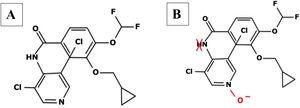
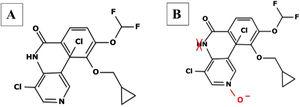
Recurrent aphthous stomatitis (RAS) and Behçet’s disease (BD) are part of the Behçet spectrum disorders (BSD), sharing genetic traits and characterized by recurrent ulcers. No systemic treatment is approved for RAS or incomplete BD, despite significant quality-of-life impacts.
Objective
To evaluate the efficacy of roflumilast, a PDE4 inhibitor, in BSD patients and compare responses between RAS and BD.
Methods
This analytical observational study included a total of 33 patients with BSD (22, RAS; 11, BD) from 5 Spanish centers, followed over 52 weeks. Data were collected retrospectively and prospectively, assessing flare-ups, ulcers, pain, and duration. Statistical models compared outcomes across treatment periods.
Results
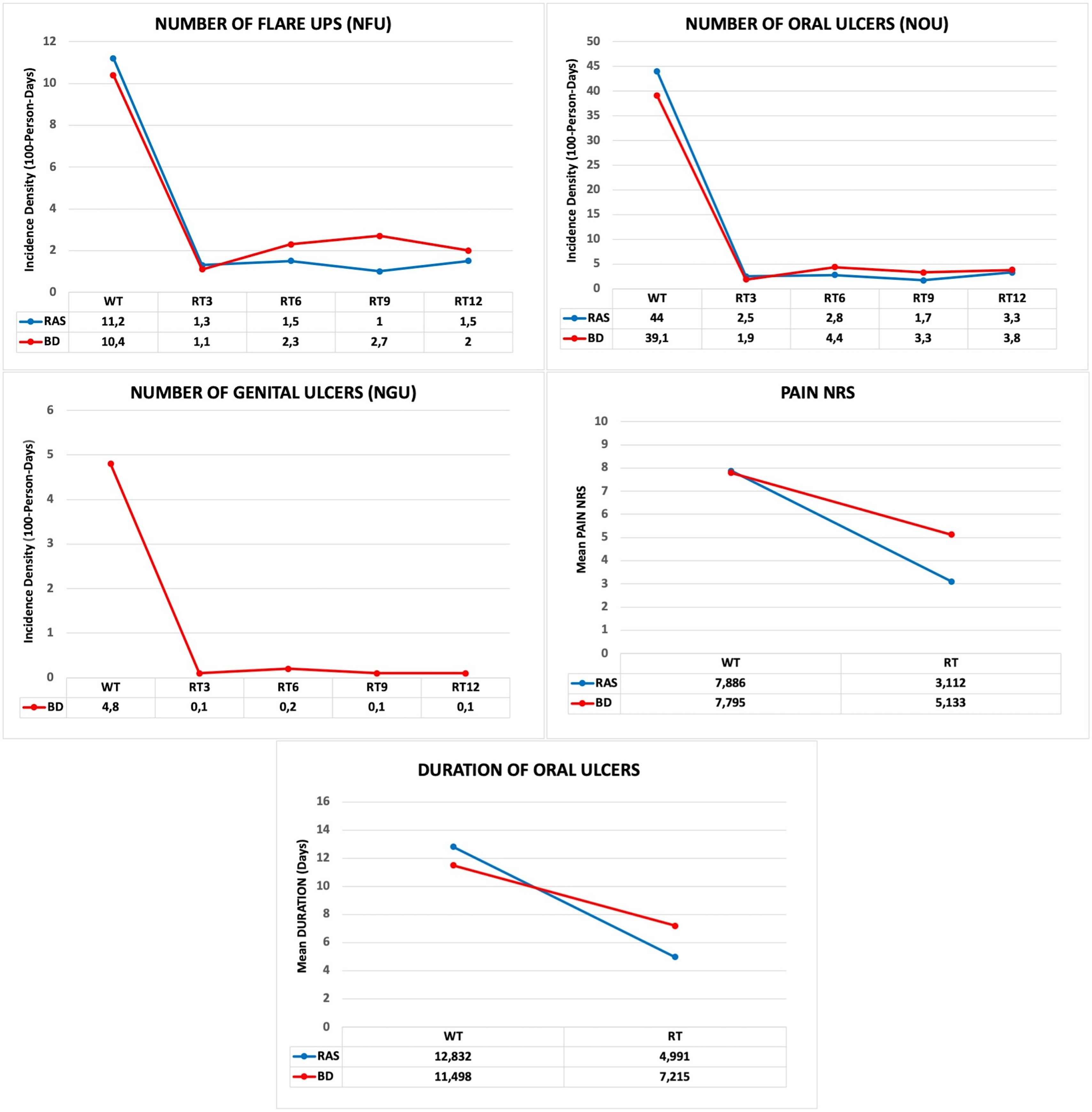
Roflumilast significantly reduced all studied response variables, with no loss of long-term efficacy. Differences between RAS and BD were minimal and clinically irrelevant. Adverse events occurred in 63% of patients, mostly mild and self-limiting, with tolerability improved through dose adjustments. Two patients (6.25%) dropped out due to adverse events.
Conclusion
Roflumilast is effective for managing BSD, offering a safe option to address unmet needs in RAS and BD. Its favorable safety profile and long-term efficacy support its use in the routine clinical practice.