Introduction
Speech and language disturbances are very frequent in progressive supranuclear palsy (PSP). Therefore, they are part of the diagnostic criteria set forth by the International Parkinson and Movement Disorder Society (MDS) for the disease and are considered a core clinical feature. However, more studies are needed to characterize the linguistic profile of PSP, thus being able to assist in the differential diagnosis. Additionally, studies assessing linguistic differences among PSP phenotypes are needed. The objective of this study is to analyze the language alterations presented by patients with PSP, as well as its different phenotypes, and differentiate them from those presented in patients with Parkinson's disease (PD).
Methods
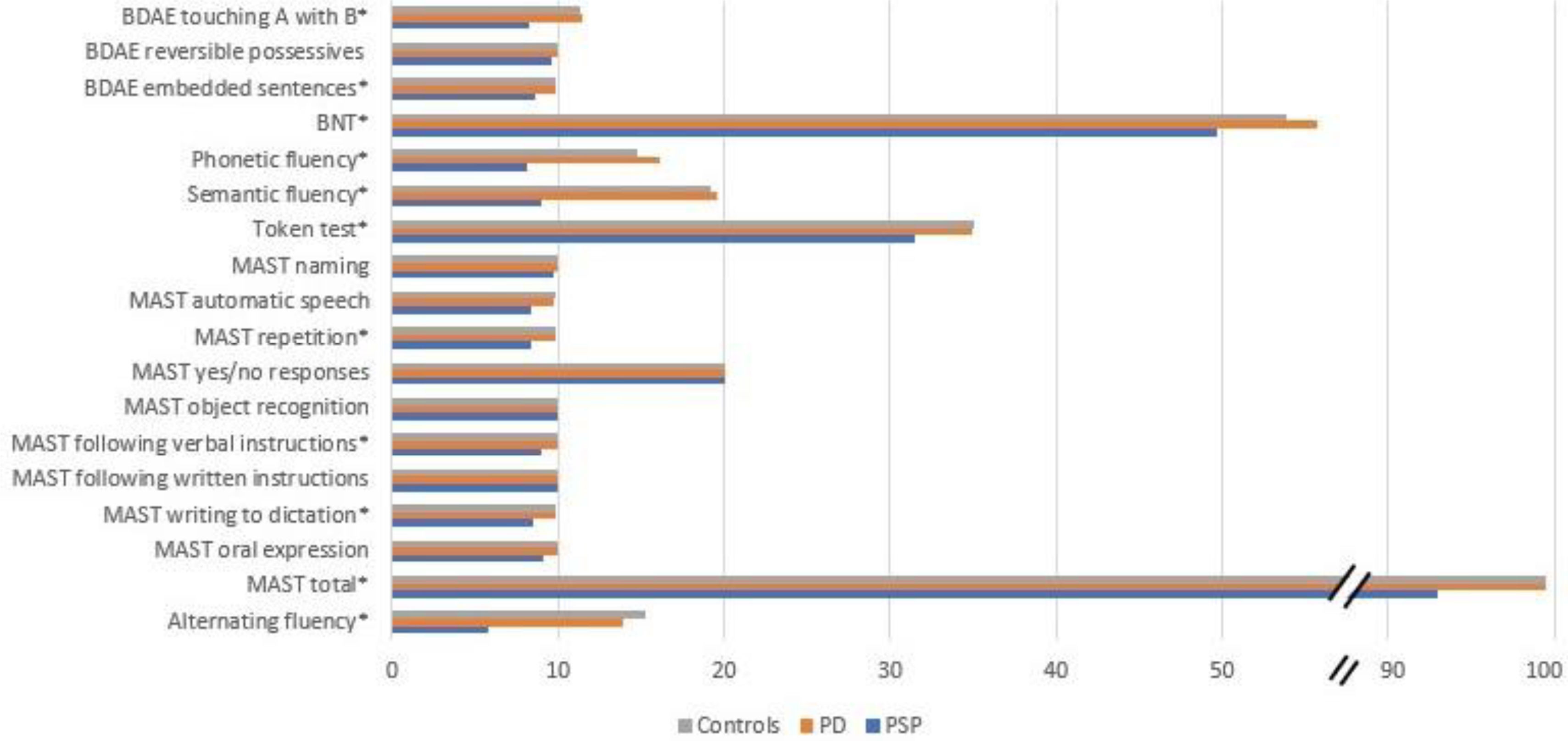
An extensive cognitive and linguistic assessment was administered to 13 PSP patients, 19 PD patients and 19 healthy controls (HC) with similar sociodemographic features. Language assessment included evaluation of: syntactic processing, object naming, and phonetic and semantic fluencies. We included a subgroup of 6 PSP patients, 19 PD patients and 19 HC for further analysis of language. This analysis included, in addition to the general evaluation, the assessment of alternating fluency, comprehension, naming, automatic speech, repetition, object recognition, verbal and written instructions, writing to dictation, and oral expression.
Results
We found greater impairment on phonetic, semantic, and alternating fluencies, following verbal instructions, repetition, syntactic processing and writing (without phonetic paragraphia) in the PSP group compared to patients with PD and HC. Distinguishing linguistic features of PSP with a less marked reduction than the previously mentioned features were automatic speech, fluency of speech, and naming. Language analysis did not distinguish between PSP phenotypes.
Conclusions
Language disturbances distinguish PSP from PD and HC but were not able to discriminate PSP phenotypes.