Background
The safety and efficacy profile of dupilumab in the management of atopic dermatitis (AD) are established in clinical trials. However, long-term real-world persistence data in Spain are limited.
Objective
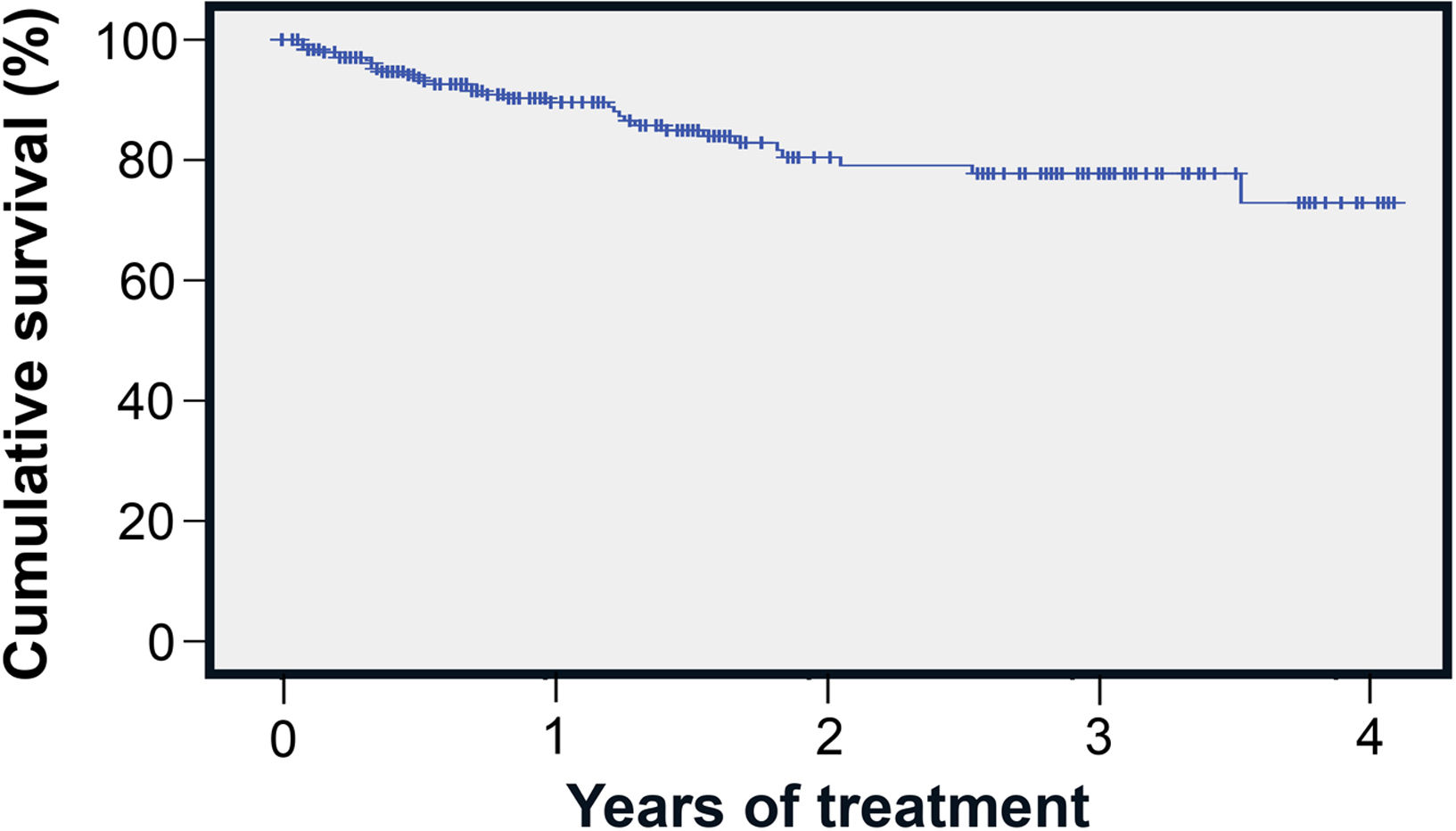
The primary endpoint of the study was to assess the 4-year persistence of dupilumab in routine clinical practice in patients with moderate-to-severe AD. Secondary endpoints included the analysis of safety and efficacy profile during the same period of time.
Methods
We conducted a retrospective cohort study of dispensation registries and health records from 5 hospitals. Adults with moderate-to-severe AD starting on dupilumab treatment were followed for 4-years. Dupilumab persistence was estimated using Kaplan–Meier analysis. Efficacy was measured by changes in EASI and IGA scores. Significant adverse events (AEs) leading to discontinuation were recorded.
Results
A total of 251 patients included (mean age, 46 years; 59.4%, men; 64.5% with at least 1 atopic comorbidity; mean time from AD diagnosis, 14.5 years). Of these, 196 (78.1%) had been on ≥2 systemic therapies before starting dupilumab. Baseline EASI and IGA values averaged 27.9 and 4.0, respectively. Persistence rates were 90%, 80%, 78%, and 73% after 1, 2, 3, and 4-years, respectively. By 16 weeks, 47.8% and 54.7% of patients achieved EASI ≤3 or IGA ≤1, increasing to 76.3% and 77.2% by 52 weeks, and reaching 90.9% in the group followed for >3 years. A total of 38 patients (13.5%) discontinued dupilumab, mainly due to inefficacy (5.6%) and AEs (1.2%).
Conclusion
Dupilumab effectively reduced AD severity within the first few weeks, with most patients achieving mild/minimal disease activity or complete clearance by year 1. The observed safety profile was consistent with known data. High persistence rates up to 4-years suggest satisfaction with dupilumab long-term safety and efficacy profile in managing moderate-to-severe AD.