Introduction
The Objective Structured Clinical Examination (OSCE) is widely used to assess clinical competence in health professions education but is commonly positioned as a summative assessment, limiting recognition of its pedagogical value for interprofessional learning.
Materials and methods
A convergent parallel mixed methods design was conducted among 188 senior nursing students and medical clinical clerks participating in an interprofessional OSCE. Quantitative data were collected using validated perception and attitude scales, while qualitative data from open-ended feedback were analyzed using Braun and Clarke’s thematic approach. Findings were integrated through joint displays to inform pedagogical interpretation.
Results
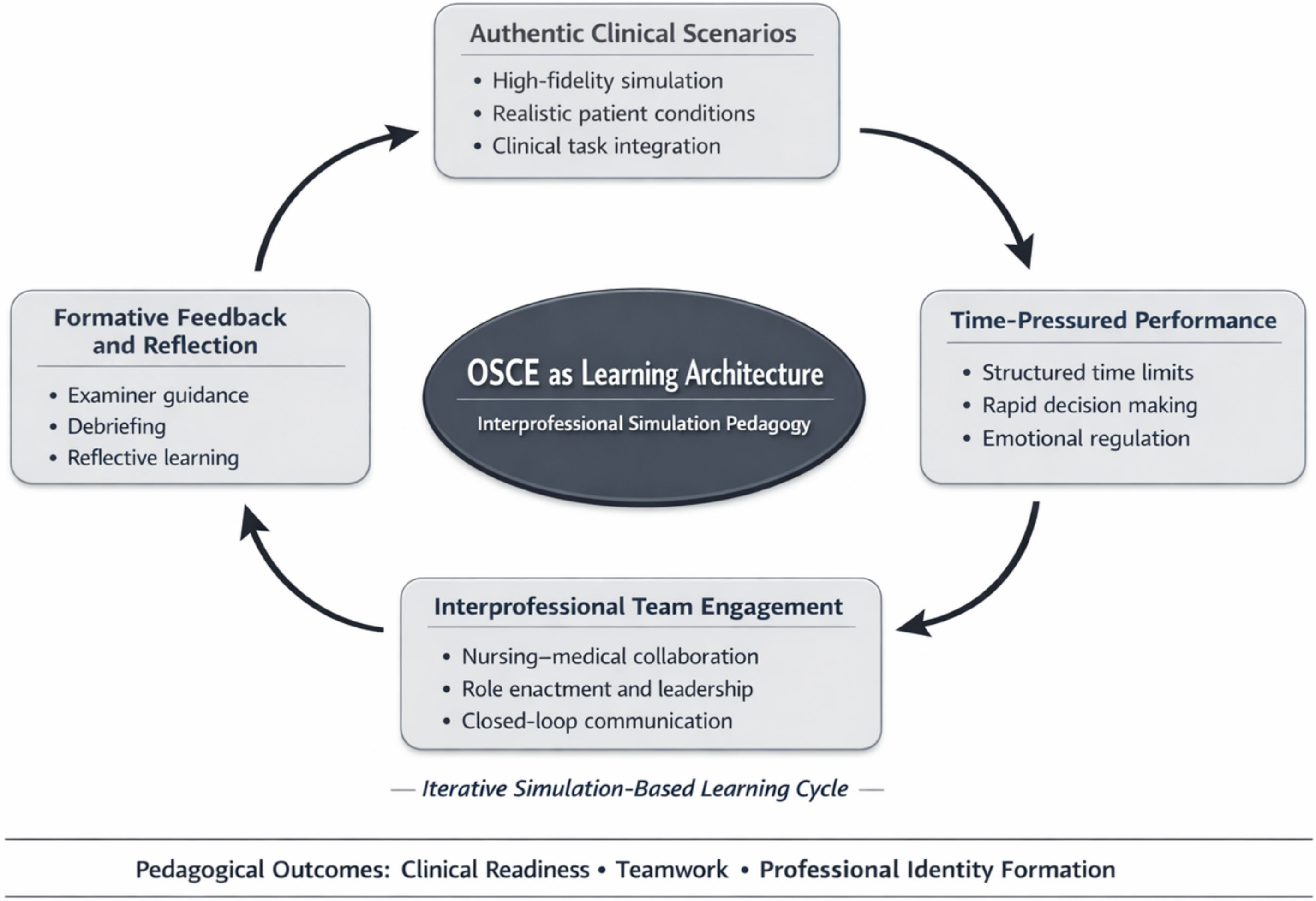
Quantitative results showed highly favorable perceptions of realism, organization, confidence building, and educational value. Qualitative analysis identified authentic simulation, confidence and professional identity formation under pressure, interprofessional teamwork, and logistical constraints as key dimensions influencing learning.
Conclusion
When intentionally designed and facilitated, the OSCE functions as an interprofessional simulation pedagogy that supports clinical readiness, teamwork, and decision-making beyond assessment.