
Aim
This study aimed to identify the key beliefs underlying the performance of walking under a clinically established pattern in women with fibromyalgia, distinguishing between those held by high vs. low intenders and high vs. low performers.
Design
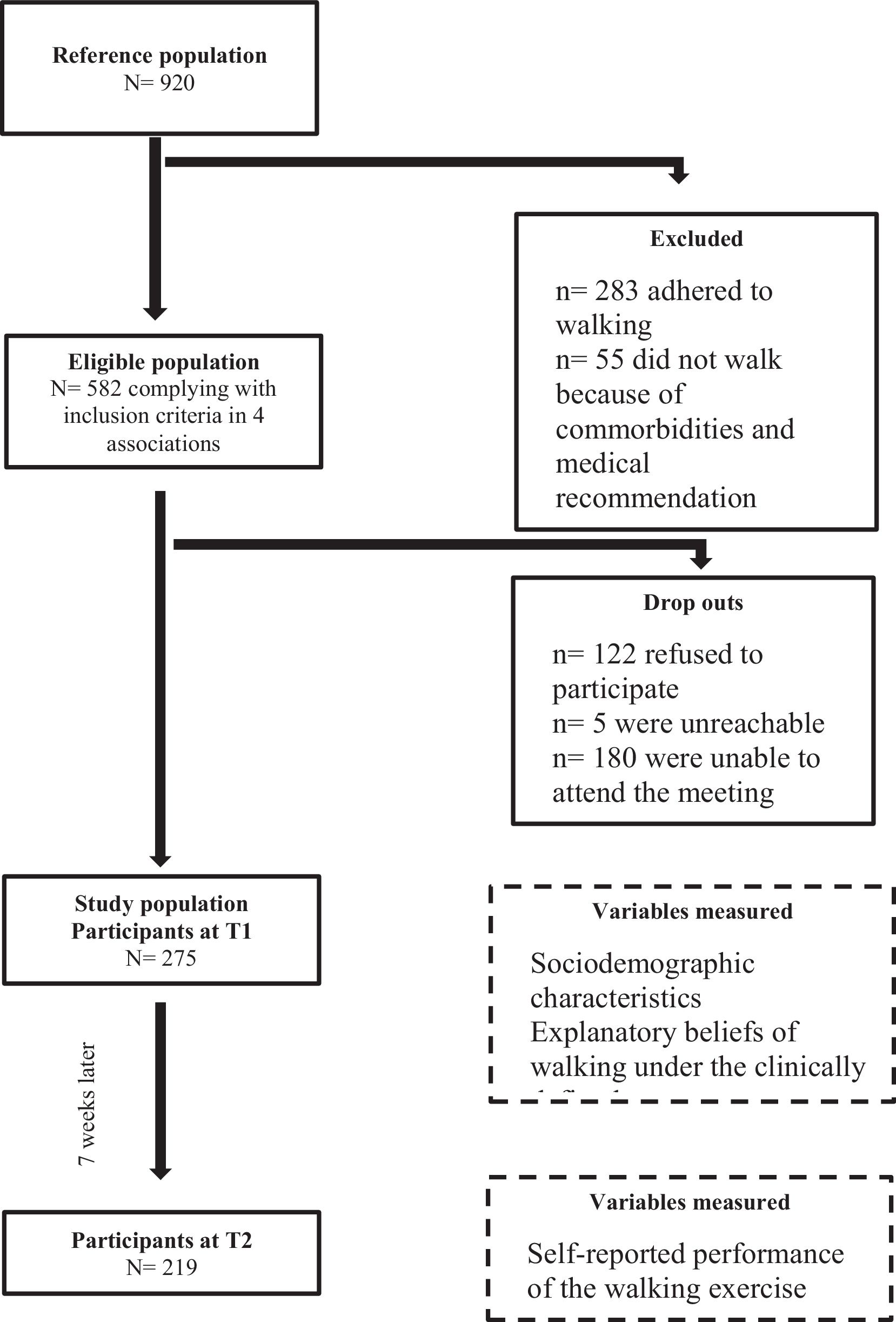
Longitudinal prospective study with measures taken at two time points (T1 and T2) over a seven-week interval.
Location
Associations of fibromyalgia of Alicante and Madrid.
Participants
At T1, 275 adult women with fibromyalgia diagnosis attending associations and that did not perform the walking exercise under the clinically established pattern. At T2, 219 women completing the follow-up.
Main measures
With questionnaires, we assessed the strength of the behavioral, normative and control beliefs in relation to participants intention to engage in walking exercise (T1) and their actual performance (T2).
Results
Among high and low intenders of performing the walking exercise, significant differences were found regarding the median strength of eight behavioral beliefs (rank: U=4389.0, p≤.001; U=2356.5, p≤.05) and one facilitator control belief (U=4211.5, p≤.001). Significant differences among high and low performers were found regarding one inhibitor control belief (t=2.6, p≤.01).
Conclusion
To enhance motivation for walking exercise, eight specific behavioral beliefs should be targeted. However, for women to initiate and maintain adherence, reducing the strength of an inhibiting belief is required. This study provides the targets for primary health professionals to promote the walking exercise among women with fibromyalgia.
