
Background and objective
Diagnosis of vibratory urticaria/angioedema is established after performing the vortex provocation test. There is current consensus on measuring the forearm perimeter after running such test to define a positive response to it.
Material and method
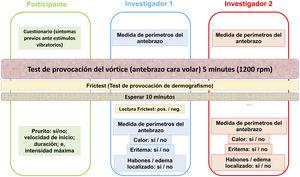
We evaluated the frequency of prior symptoms following vibratory stimuli in volunteers using a questionnaire, response to the vortex provocation test in the same volunteers (increase in forearm perimeter, erythema, localized edema, heat, and pruritus), inter-rater reliability, and correlation between the scores obtained in the questionnaire and response to the test.
Results
A total of 40 volunteers participated in this survey, 17 of whom were excluded due to dermographism. A total of 59% out of 123 without dermographism responded positively to ≥1 items of the questionnaire. Localized erythema, heat or localized edema were reported in 58.5%, 38.2%, and 32.5%, respectively. A total of 73.6% of volunteers presented with itch. The mean intensity of itch was 3.44, 95% CI, 2.94–3.94. Inter-rater agreement was low regarding the increase in forearm circumference at three levels (intraclass correlation coefficient, 0.477, 95% CI: 0.253–0.634; 0.496, 95% CI: 0.280–0.647; and 0.370, 95% CI: 0.100–0.559, respectively) and optimal regarding erythema, heat and localized edema (kappa index, 0.868; 0.756; and 0.757, respectively). A significant correlation was identified between the questionnaire score and the altered response to the test in its different variables.
Conclusions
We propose the following variables: erythema; localized edema; heat; and the intensity/speed of onset/duration of pruritus to define a positive response to the vortex provocation test given their ease of execution and optimal inter-observer agreement.