
Aim
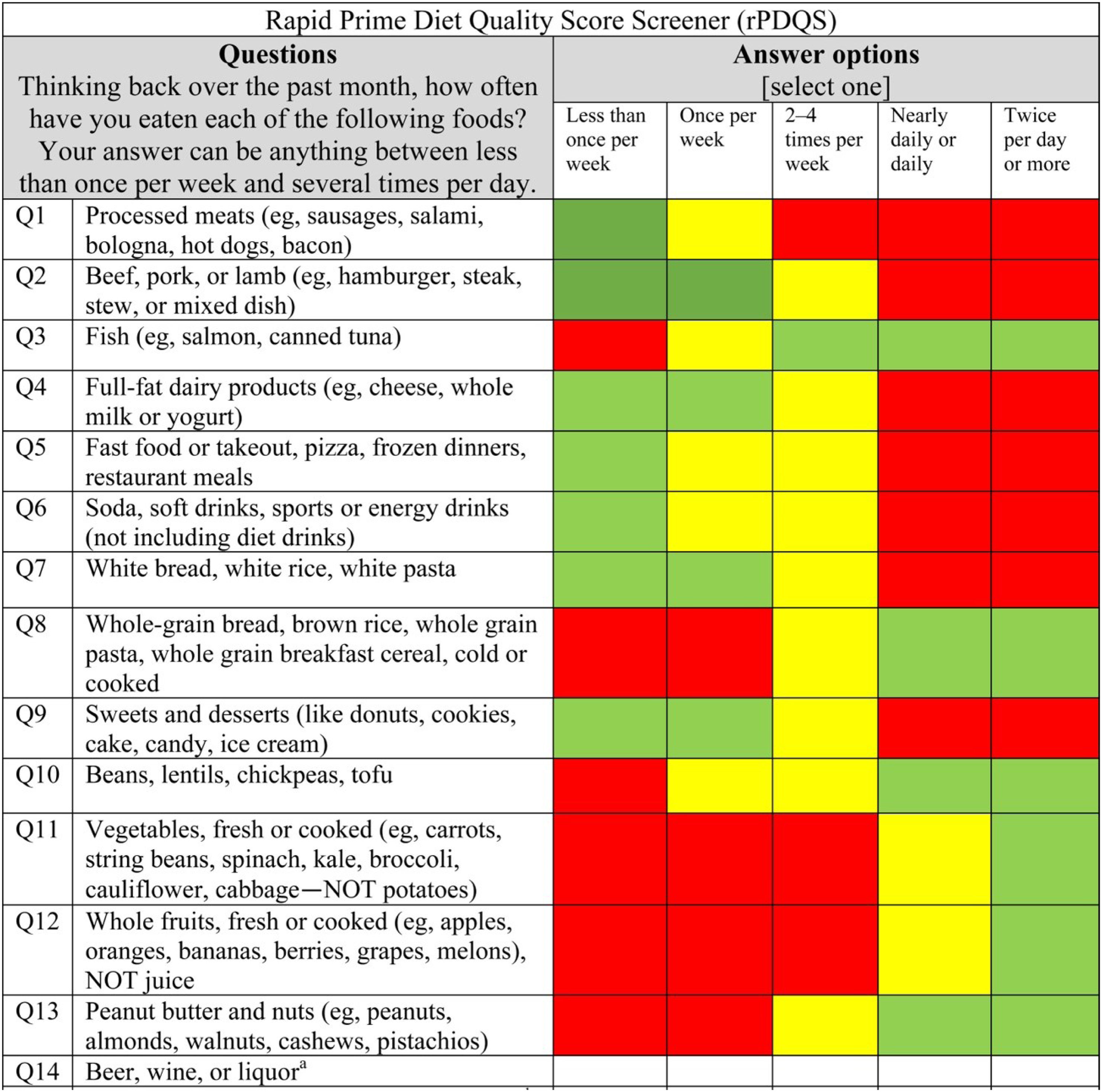
To translate and cross-culturally adapt the Rapid Prime Diet Quality Score Screener (rPDQS) for use in Spanish primary care.
Design
Translation, cross-cultural adaptation and pilot testing.
Site
Mallorca Primary Care Centers.
Participants
Primary care professionals and healthcare university students (n=29) and patients from primary care (n=71).
Interventions
Administration of the rPDQS for cognitive debriefing and pilot testing in primary care.
Main measurements
Translation and cultural adaptation followed ISPOR and Beaton guidelines, including forward translation, synthesis, back-translation, expert review, pretesting, and final evaluation. Pretesting comprised cognitive debriefing and pilot testing in primary care to assess comprehension, cultural relevance, feasibility, and acceptability.
Results
Only minor linguistic and cultural refinements were required, such as refinement of cooking terms and inclusion of culturally familiar examples, without modifying the underlying constructs of the original instrument. One item relating to full-fat dairy products was identified as inconsistent with current Spanish/European dietary guidelines and was therefore removed from scoring. Examples of sweetened dairy products were added to better capture free-sugar intake. In pilot testing, the Spanish rPDQS showed good acceptability and feasibility. The mean completion time was 7min, <10% of participants required assistance, and 92% rated items as clear and culturally appropriate. Women had higher numeric scores than men, higher education and lower BMI were associated with better diet quality.
Conclusions
The Spanish version of the rPDQS shows strong linguistic, conceptual, and cultural equivalence with the original instrument and represents a feasible, clear, and culturally appropriate tool for assessing diet quality in Spanish primary care.