Objective
To examine the independent and joint associations of physical activity (PA) and dietary quality (HEI-2020) with the presence of advanced cardiovascular-kidney-metabolic syndrome (CKM) in older U.S. adults.
Design
A cross-sectional study.
Site
The 2007–2020 National Health and Nutrition Examination Survey (NHANES).
Participants
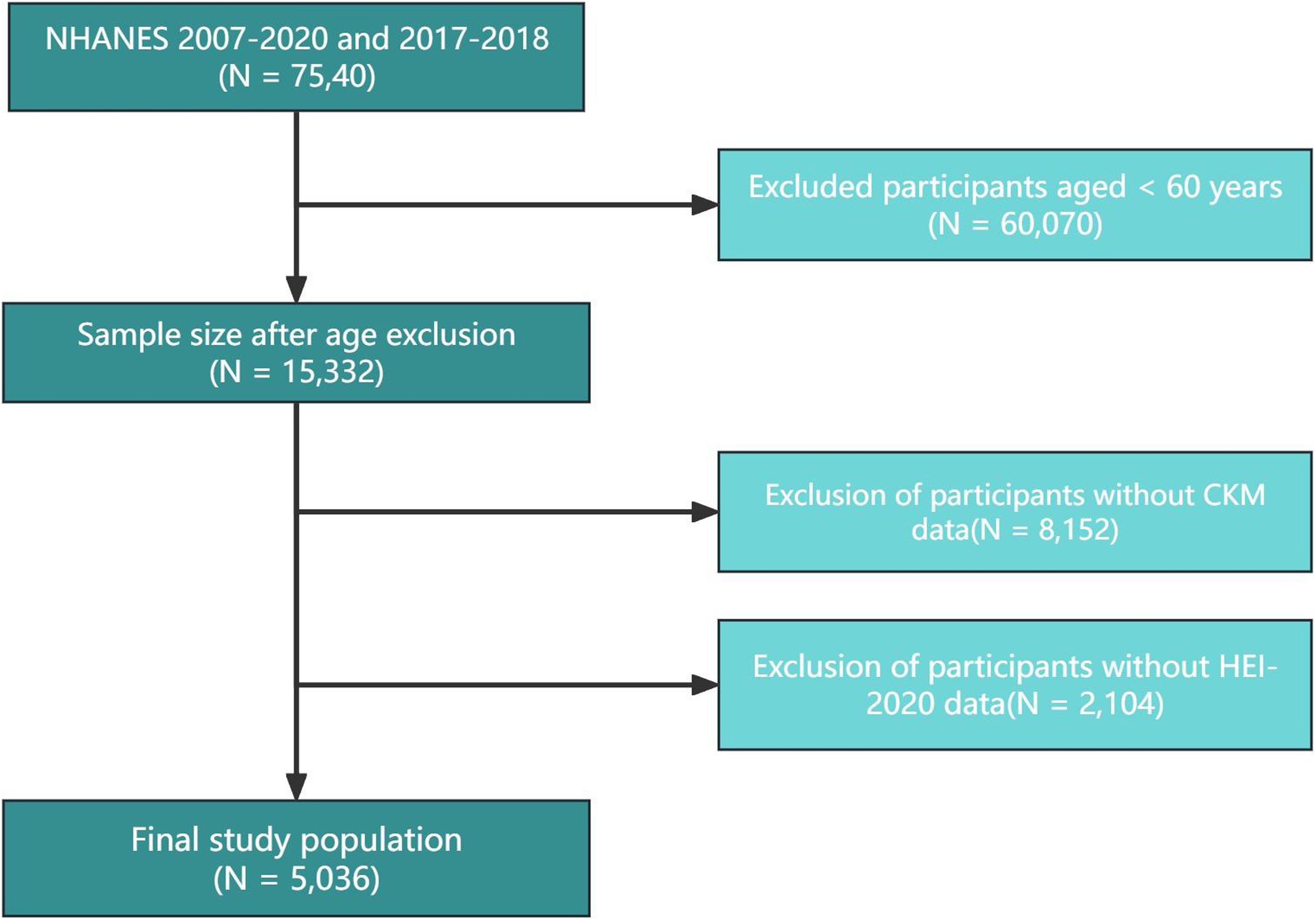
Five thousand thirty-six individuals aged ≥60 years (2051 with advanced CKM).
Main measurements
PA was measured using MET-min/week, and dietary quality was assessed via the HEI-2020 score. Weighted logistic regression, restricted cubic spline (RCS) analysis, mediation, and stratified analyses.
Results
Sufficient PA (OR=0.66, 95% CI: 0.54–0.80) and HEI-2020 ≥60 (OR=0.82, 95% CI: 0.67–0.99) were independently associated with lower odds of advanced CKM, with the strongest association observed for the combination of both factors (OR=0.49, 95% CI: 0.38–0.64). RCS analysis revealed a nonlinear association between PA and advanced CKM, while HEI-2020 showed a linear inverse association. Mediation analysis indicated that BMI and HDL-C accounted for 15.7% and 23.1% of these associations, respectively. Stratified analyses suggested stronger associations among individuals aged ≥70 years, women, and widowed, divorced, or separated individuals.
Conclusion
Physical activity and dietary quality were jointly associated with lower odds of advanced CKM in older adults, and these associations may involve metabolic and inflammatory pathways. Multidimensional lifestyle strategies may be beneficial for populations with a higher burden of CKM, although longitudinal studies are needed to clarify temporality.