Introduction
Early surgical exposure and simulators in medical schools are fundamental in the education process. These techniques allow students to practice and subsequently improve their skills in clinical and surgical practice. The aim was to determine early exposure to an active surgical clerkship among medical students and identify their viewpoint to improve surgical education.
Materials and methods
This cross-sectional observational study was carried out among medical students (N = 80) in the 5th and 6th year. A 5-item Likert-scale questionnaire assessing surgical exposure, clerkship characteristics, and simulator use was validated via a pilot test (Cronbach’s (α) > 0.70). Statistical analyses, including Wilcoxon rank-sum and Fisher’s exact tests, were conducted using Stata.
Results
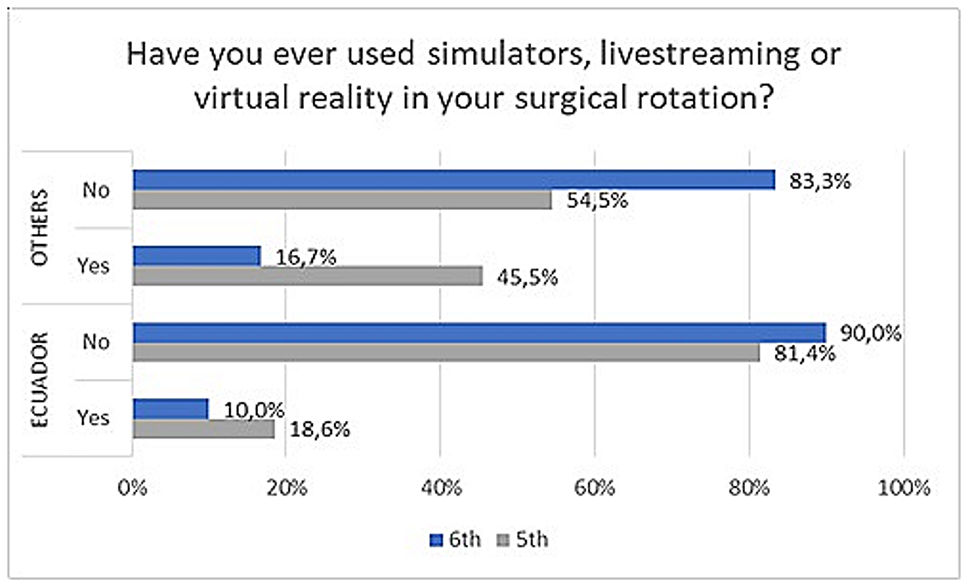
A significant difference was observed regarding skill development perceptions (p = 0.008), with Ecuadorian students (n = 63) reporting higher satisfaction than international students (n = 17). No significant differences were found for career motivation (p = 0.298), with 82.4% of international and 66.7% of Ecuadorian students strongly agreeing that hands-on rotations increase surgical interest. Active rotations were fully recommended over observerships by 82.4% of international and 87.3% of Ecuadorian respondents (p = 0.468). Exposure to simulators trended higher among international students (35.3% vs. 15.9%; p = 0.093).
Conclusion
Early surgical exposure could help students develop skills during their clinical placements, and students choose to participate in these placements because they achieve learning objectives during their rotations. In addition, simulation and virtual learning were recommended by a large proportion of students.