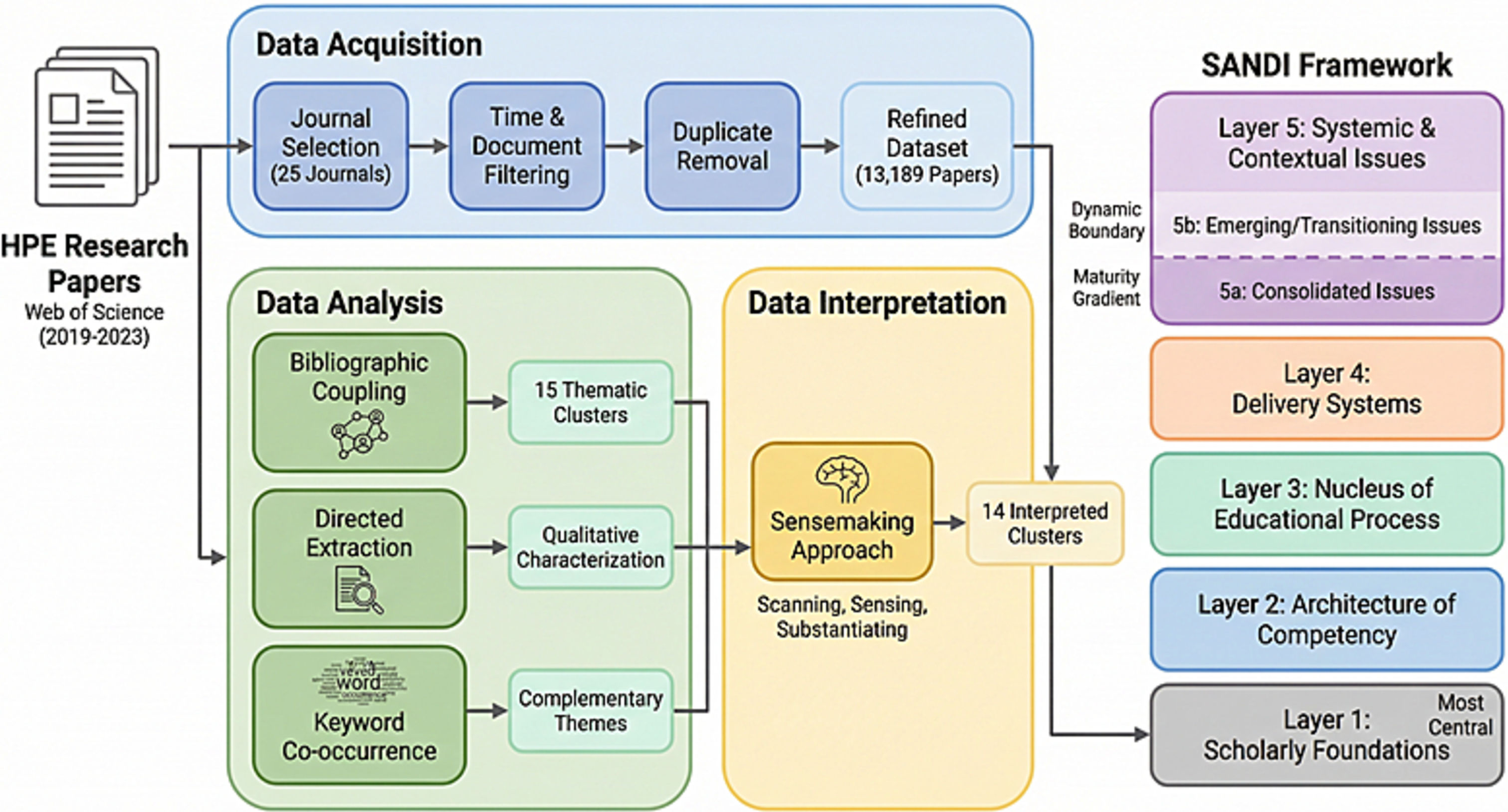
Health professions education (HPE) research has grown rapidly, yet lacks a framework that organises its thematic structure hierarchically; prior classifications relied on keyword approaches and lacked qualitative verification. We aimed to identify this structure through bibliographic coupling, enrich it through directed extraction, and organise it hierarchically. We conducted a bibliometric analysis of 13,189 papers published between 2019 and 2023 across 25 HPE journals indexed in Web of Science. Bibliographic coupling using VOSviewer identified 15 clusters within a network of 2000 papers meeting the ≥10-citation threshold; directed extraction of 450 high-impact papers characterised each cluster, and keyword co-occurrence provided a complementary lens. Data interpretation followed the sensemaking approach (scanning, sensing, and substantiating). Fourteen clusters were organised into the SANDI framework: Scholarly Foundations, Architecture of Competency, Nucleus of Educational Process, Delivery Systems, and Issues; one cluster was excluded as an artefact. Scholarly Foundations emerged as the most intellectually central cluster, a finding without precedent; Layers 1–4 constituted a structurally stable replicated core, while Layer 5 exhibited a maturity gradient from consolidated systemic forces to emerging themes. The SANDI framework offers the first empirically derived, hierarchical taxonomy for organising HPE research.