Background
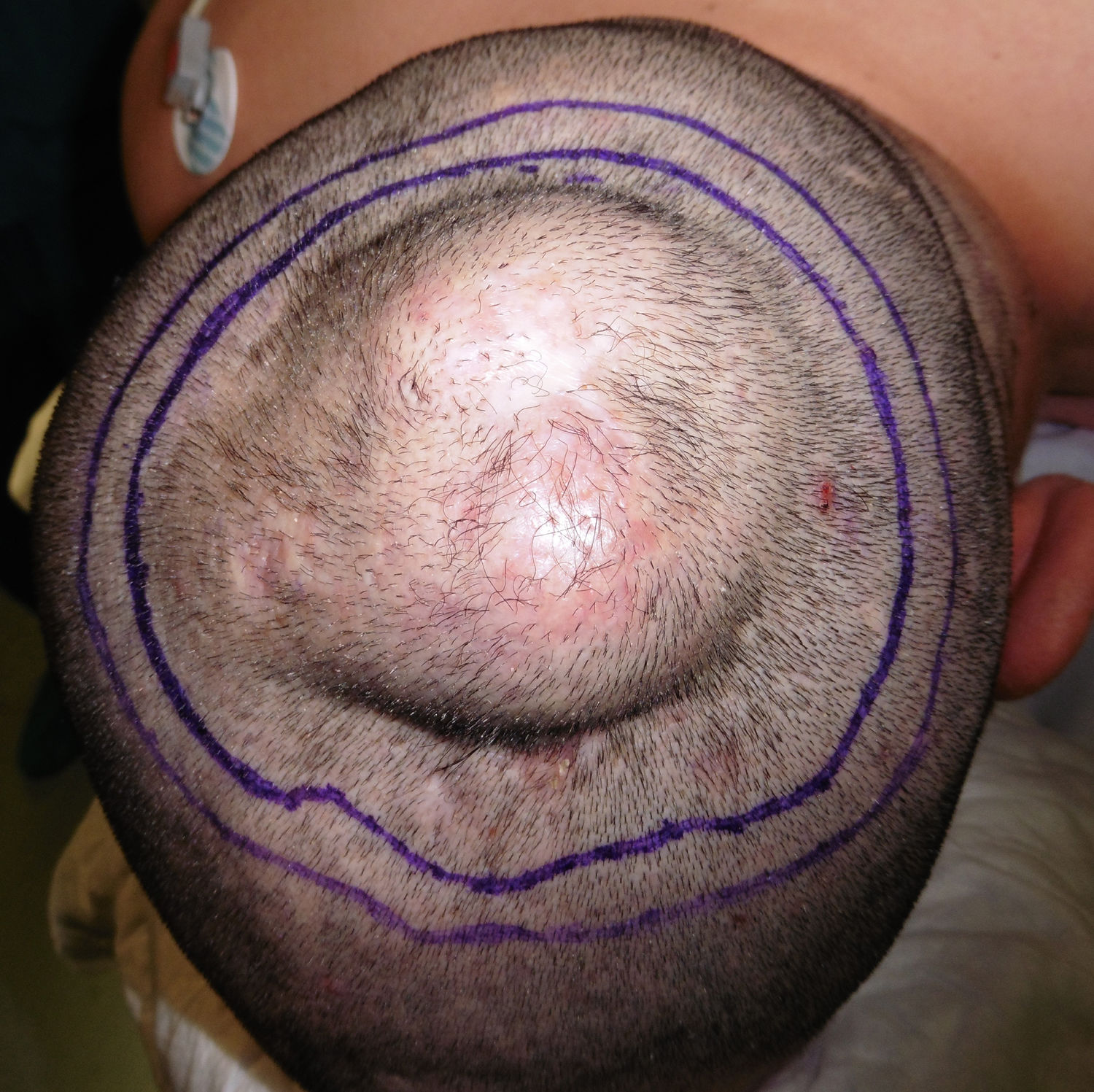
Dermatofibrosarcoma protuberans (DFSP) is a rare tumor that affects the head in 10–15% of cases. Head DFSP is often associated with more complex surgery and a higher rate of local recurrence.
Objective
To compare the clinical, histopathologic, and surgical characteristics of head DFSP vs body DFSP in order to identify potential risk factors.
Methods
Retrospective study.
Results
Of 235 DFSP, 32 (13.6%) were located on the head. Histologically, 71.0% of head DFSP vs 7.4% of body DFSP were purely subcutaneous with no dermal involvement (P<.001). Tumor infiltration of the superficial muscle and/or periosteum was observed in 81.4% of head tumors vs 18.7% of body tumors (P<.001). Focal muscle involvement was present in 90.0% of facial DFSP, and periosteal involvement was present in 50.0% of scalp DFSP. Two or more stages of modified Mohs surgery were required in 71.0% of head DFSP vs 35.9% of body DFSP (P=.002). After a mean follow-up of 6.7 years, recurrences were significantly more common in head DFSP (3/32, 9.4% vs 3/203, 1.5%; P=.035). Head tumors recurred significantly later than body tumors (mean, 7.2 vs 1.5 years; P<.001).
Limitations
Retrospective design.
Conclusions
Head DFSP is typically subcutaneous and often focally infiltrates the superficial muscle in facial lesions and the periosteum in scalp lesions. Longer follow-up for head DFSP is advisable.